

Our products

ADD:NORTH PETG – 1.75MM – 750G – MEDIUM BLUE
December 17, 2020
ADD:NORTH PETG – 1.75MM – 750G – YELLOW
December 17, 2020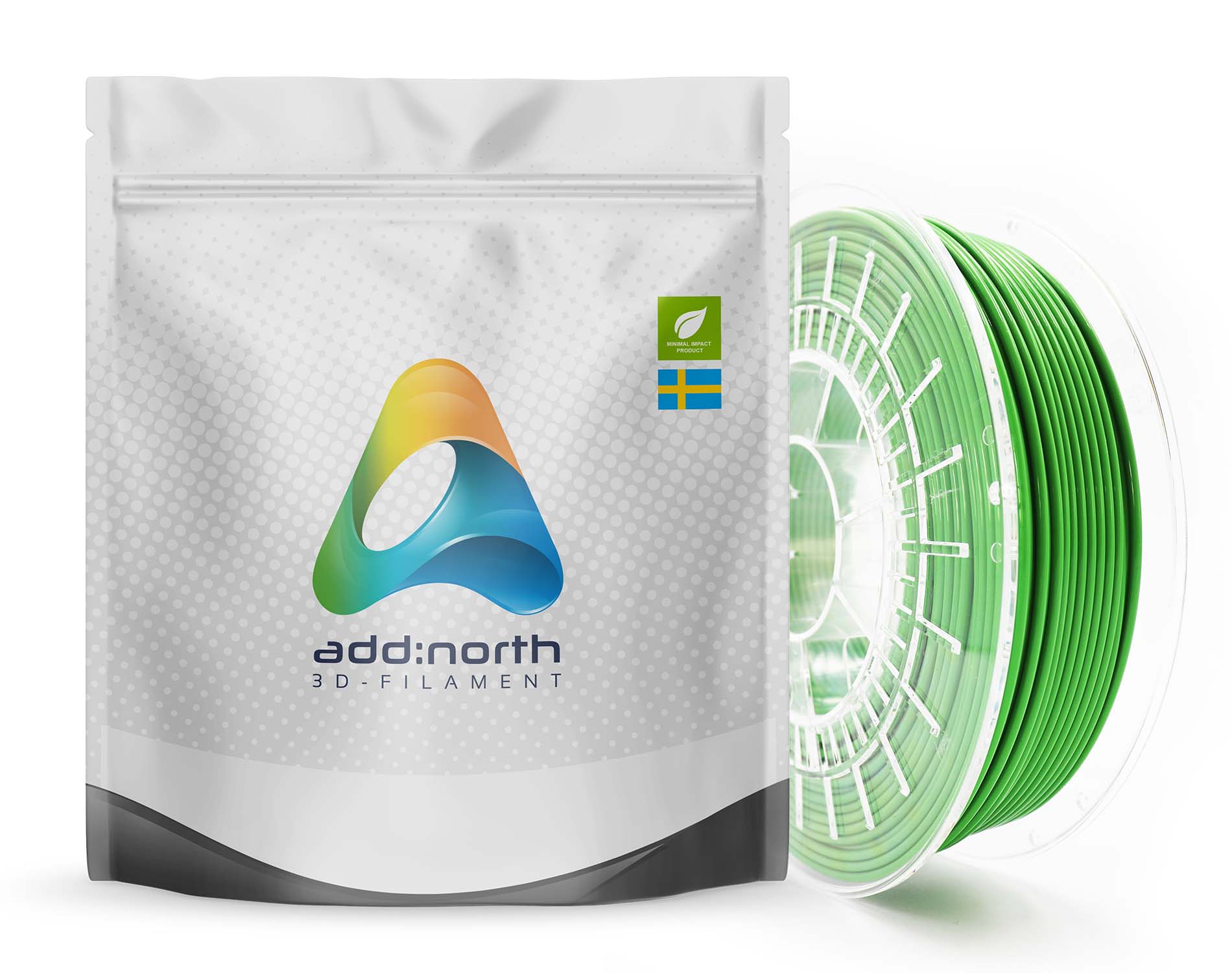
ADD:NORTH PETG – 1.75MM – 750G – GREEN
27.99€ inc. VAT
add:north’s PETG combines the properties from both PLA and ABS.
It is odorless, has low warping and a high impact resistance. PETG also has the highest transparency among all our filaments and is available in a number of different colors.
PETG has grown to be one of the most popular materials for many users. It has in many ways replaced ABS as the primary material for technical applications mainly because of its chemical resistance.
4 in stock
SPECIFICATIONS
| Material | PETG |
| Diameter tolerance | ± 0.025 mm |
| Heated build platform | No (or up to 80 °C) |
| Print temperature | 225-260 °C |
| Density | 1.22-1.25 |
| Continuous work temp | 75°C |
| UV resistance | High |
| Chemcial resistance | High |
| Hygroscopy | High |
| Wear resistance | High |
| Spool size | 200 x 55 mm (750 g) |
| Spool hub diameter | 52 mm |
| Weight empty spool | 215 g |
| Weight filament | 750 g |
PRINT GUIDE
Temperatures
225-260 degrees in the nozzle and up to 75 degrees on the build plate. There are two primary factors influenced by the temperature:
- Layer adhesion. Layer adhesion increases with increased temperature. It is usually good for bed adhesion to also print the first layer a bit warmer than the rest of the model, on the nozzle as well as the print bed.
- Flow. With increased temperature, the flow increases (the viscosity decreases). This may have to be compensated with a somewhat increased retraction distance and retraction speed. Conversely, low-temp prints needs a bit less retraction. Always try to use as little retraction (distance and speed) as possible, so it just prevents the stringing you want to get rid of.
We recommend to print a temptower when first using a new material, to find the sweetspot of your printer.
Build plate adhesion
PETG requires the build plate to not be to tightly leveled to the nozzle. A correctly calibrated build plate for PETG is when the nozzle is about one layer height away from the platform so that the plastic is not squeezed out, but rather is laid down in clean strings in the first layer. Otherwise, plastic residue might accumulate on the nozzle and follow it around and stick to the following layer which decreases the print quality. Surfaces that works well with PETG:
- PEI/buildTak: Very good adhesion, even at lower build plate temp or even cold build plate
- Painter’s tape: Good and easy alternative if you do not have PEI or BuildTak.
- Heated glass: If the print does not stick, increase the temp in intervals of 5°C. Also make sure the room temperature is ambient.
Quality
Quality is a complex area where hardware and slicer have big impact. Every new filament needs in general some tuning to achieve its full potential, usually through printing some calibration models and adjusting iteratively. We have gathered our favourites here.
- Fan: If you want a high visual quality on PETG prints but slightly less layer adhesion, use a lot of fan, but if you rather want stronger prints, use little or no fan.
- Printspeed and layer height: It is easier to get a higher visual quality with lower speeds and lower layer heights, which increases the resolution. Many times, though, it is desireable to produce ones print as fast as possible. The factor that need primary attention when increasing layer height and print speed is nozzle temperature. When the flow through the nozzle increases, there is less time for the plastic to melt, which then requires a somewhat increased temperature to achieve good results. We recommend 60mm/s and 0.15mm layer height as a starting point.
- Stringing: Is reduced with increased retraction distance and retraction speed. We recommend about 5mm for bowden and 2mm for direct drive, with a speed of about 30-40mm/s. Also have z-hops activated and turn combing mode off (in cura).